
How to make rosin diamonds is a question that has moved from closed-loop laboratories into home garages and small craft kitchens over the past few years. 🌿 The technique is no longer a trade secret guarded by hydrocarbon extractors. Solventless diamond production is now accessible to anyone with a rosin press, a cold-cured slab, and the willingness to learn a slow, finicky, deeply rewarding process.
But before you fire up your plates, understand what you are attempting. Rosin diamonds are not simply pressed rosin. They are crystallized THCA that has been mechanically separated from the terpene-rich sauce that surrounds it in whole rosin. The separation happens because THCA melts at a higher temperature than the terpenes and lipids around it. Apply just enough heat and pressure, and the sauce flows out while the THCA stays behind . The result is a chalky white powder that can be melted into clear, glassy diamonds or recombined with the sauce for a full-spectrum diamond sauce experience.
The Starting Material: Why Cold Cure Matters
How to make rosin diamonds successfully begins weeks before you touch a press. The single most common mistake home extractors make is attempting separation with fresh press rosin. Fresh press is glassy, volatile, and stubborn. It does not want to release its terpenes. The THCA is locked in a matrix that resists mechanical separation, and your press will simply squish the whole slab into a thinner, equally glassy puddle.
You need cold-cured rosin with a waxy, stiff budder texture . If you only have fresh press, you can convert it by sealing it in a jar at room temperature for two to three days and then whipping it until it nucleates into a crumbly, waxy consistency. Some extractors prefer to encourage this transition in a warm environment—around 100–110°F—for 24 to 48 hours until the rosin loses its glassy sheen and becomes opaque . The goal is a texture that crumbles when you press a tool into it, not one that stretches or shatters.
This is where liquid diamonds vs live resin vs live rosin becomes a relevant distinction for the home extractor. Liquid diamonds in commercial vape products are often made through solvent-assisted crystallization or by melting isolated THCA into a terpene base . Live liquid diamonds vs live rosin comes down to the starting material and the solvent question: live rosin is mechanically pressed from ice water hash, while many liquid diamond products begin with hydrocarbon extraction before crystallization. When you make rosin diamonds at home, you are choosing the solventless path. Your starting material is hash rosin or flower rosin, and your separation tool is heat and pressure alone.
Equipment: What You Actually Need
How to make rosin diamonds requires less equipment than most people expect, but precision matters more than volume. You need a rosin press with programmable temperature control—hydraulic is preferred for smooth pressure application . A standard dab press with accurate low-temperature capability will work. You also need filter bags in two sizes: 25µm for the inner wrap that retains the THCA crystals while allowing terpenes to pass, and 220µm for outer structural support . Some guides recommend a 15µm inner screen and a 37µm outer bag, but the principle is the same: a fine inner mesh to catch crystals and a coarser outer mesh to hold everything together under pressure .
You will also need food-grade parchment paper (PTFE-coated is ideal for clean collection), a collection tool, and optionally a heating plate or vacuum oven for the melting stage. A silicone mold is useful if you want shaped diamonds, but it is not strictly necessary. The entire process can be completed on a sheet of parchment if you are careful .
Step One: The Separation Press
How to make rosin diamonds begins with bagging your cold-cured rosin. Flatten the rosin into a square roughly one-eighth to one-quarter inch thick. Place it inside the 25µm bag and fold the end over. Sleeve the 220µm bag over the first bag for support . The double-bag structure is not optional—the fine inner mesh will tear under pressure without the outer bag holding it together.
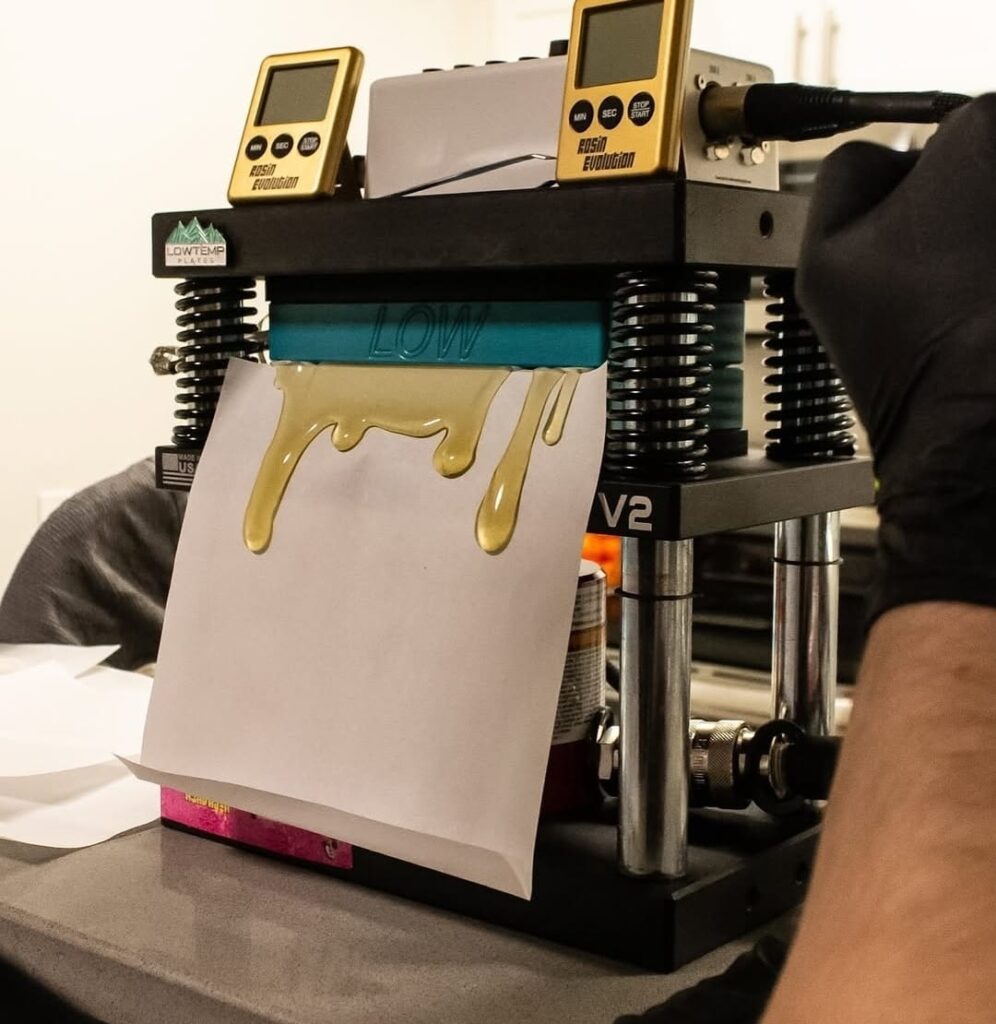
Set your press plates to 105°F. This is intentionally low. You are not trying to melt the rosin; you are trying to coax the terpenes to flow while the THCA remains solid. Place the bagged rosin between folded parchment paper—a directional fold like “Boat Tech” helps channel the sauce away from the bag—and apply minimal pressure until the seam of the bag is wet. Then slowly increase pressure until the terp sauce begins to seep through the mesh and down the parchment .
Watch the flow. The sauce should be golden and liquid. If it is dark or smoking, your temperature is too high. Maintain gentle pressure for about ten minutes, or until the sauce stops flowing. Collect that sauce separately—it is intensely aromatic and valuable. Then increase the temperature to 115°F and repeat the press, followed by 125°F for a final pass . Each pass extracts more terpenes while leaving the THCA behind.
After the final press, open the 25µm bag. Inside you will find a chalky white patty. This is your crude THCA. A well-executed separation can yield 97–98% THCA purity before any melting .
Step Two: Melting and Forming Diamonds
The white THCA powder is potent but not yet diamond-like. To achieve the translucent, glassy appearance that defines rosin diamonds, you need to melt it carefully. Heat a parchment-lined surface or a silicone mold to 225°F. Do not use a vacuum—you are using the oven only for controlled, even heat . Crush the THCA patty into a fine powder and place it on the heat. Watch closely. The powder will melt rapidly into a clear liquid. As soon as it is fully clear, remove it from the heat immediately. Overheating will oxidize the THCA, turning it purple and degrading its purity.
Let the melted THCA cool at room temperature. As it solidifies, it crystallizes into hard, glassy structures—the diamonds. If you want the characteristic shine, a brief pass with a heat gun on its lowest setting can smooth the surface .
Step Three: Pure Diamonds or Diamond Sauce?
At this point you have a choice. You can package the pure rosin diamonds as they are—nearly flavorless, intensely potent, and shelf-stable. Or you can recombine them with the terpene sauce you collected during separation. This is the diamond rosin vs diamond sauce decision. Pure diamonds offer maximum THCA per gram and precise dosing. Diamond sauce offers the full spectrum of flavor and effect, with the crystals suspended in a terpene-rich liquid that carries the strain’s character . Both are legitimate. Both are solventless. The choice depends on whether you are chasing potency or the complete plant experience.
Understanding the Effects and Storage
The rosin diamonds effects are distinct from whole rosin. Because pure diamonds are almost entirely THCA with minimal terpenes, the experience is often described as a clean, cerebral, and intensely potent high. The entourage effect is muted without the terpene sauce, which is why many consumers prefer sauce-coated diamonds or whole rosin for a more rounded experience. When you dab a pure diamond, the heat converts THCA to THC, delivering a sharp, fast-acting psychoactive effect that can feel more one-dimensional than a full-spectrum extract.
How to store live rosin diamonds matters for longevity. Keep them in an airtight glass container away from heat and light. For long-term storage, refrigeration is recommended; allow the sealed container to come to room temperature before opening to prevent condensation from introducing moisture . If your diamonds are sauced, the terpene fraction is more volatile and will degrade faster than the crystals themselves. Keep the jar sealed and minimize headspace.
Why This Process Matters
How to make rosin diamonds is not just a technical exercise. It is a statement about what solventless extraction can achieve. For years, diamonds were the exclusive domain of hydrocarbon laboratories. The idea that heat and pressure alone could produce 97%+ THCA crystals seemed implausible. Now, home extractors with a $500 press and a patient weekend can produce diamonds that rival commercial products in purity, if not always in scale.
The process also deepens your understanding of what you are buying when you purchase rosin diamonds for sale. You know the texture markers to look for, the terpene content to expect, and the difference between a clean separation and a rushed one. That knowledge makes you a better consumer and, if you press your own, a better producer.
Product Specifications Table
| Specification | Detail |
|---|---|
| Product Name | Rosin Diamonds (Solventless THCA Crystals) |
| Format | Crystallized THCA from mechanical separation |
| Starting Material | Cold-cured hash rosin or flower rosin |
| Extraction Method | Solventless (heat + pressure separation) |
| Separation Temperature | 105°F → 115°F → 125°F |
| Inner Bag | 25µm |
| Outer Bag | 220µm |
| Final THCA Purity | 97–98% (before optional melt) |
| Appearance | Chalky white powder → clear glassy crystals |
| Melting Temperature | ~225°F (for clarity) |
| Storage | Airtight glass, cool dark place, refrigeration optional |
| Solvents Used | None |
| Additives | None |
Flavor
Pure rosin diamonds are nearly flavorless. The terpenes that carry aroma and taste have been separated during the press. This is not a flaw—it is the nature of purified THCA. If you recombine the diamonds with the collected terpene sauce, you restore the strain’s flavor: fruity, gassy, creamy, or floral depending on the starting material. The sauce is intensely aromatic and should be stored separately if you plan to use it later.
Aroma
From the jar, pure diamonds offer almost no aroma. The terpene sauce, by contrast, is loud—a concentrated expression of the original rosin’s profile. During the separation press, the room will smell strongly of the strain’s terpenes as the sauce flows. This is a good sign. If the sauce smells harsh or burnt, your temperature was too high.
Inhale & Exhale Experience
Inhale: A dab of rosin diamonds hits clean and expansive. Because the terpene content is low, the vapor is smooth but lacks the flavor complexity of whole rosin. The effect arrives quickly—a sharp, cerebral intensity that can feel almost immediate.
Exhale: The exhale is neutral, with a faint mineral or clean taste. No lingering flavor. The rosin diamonds effects are potent and fast, but without the entourage effect of terpenes, the experience may feel shorter or less rounded. This is why many consumers prefer sauce-coated diamonds for a more complete session.
Details
| Trait | Detail |
|---|---|
| Process Origin | Solventless crystallization technique |
| Key Equipment | Rosin press, 25µm and 220µm bags, parchment |
| Critical Texture | Cold-cured, waxy/budder rosin |
| Temperature Range | 105–125°F for separation; 225°F for melt |
| Yield Estimate | Varies; roughly 50–70% THCA by weight from starting rosin |
| Recombination Option | Mix crystals with collected sauce for diamond sauce |
Features
- 100% Solventless: Mechanical separation only.
- High Purity: 97–98% THCA achievable.
- Customizable Format: Pure diamonds or diamond sauce.
- Reproducible Process: Precise temperatures and bag sizes.
- Scalable: Works for home pressers and commercial labs.
- Educational Value: Deepens understanding of rosin chemistry.
Rosin Quality Details
Quality rosin diamonds are judged by clarity and hardness. Chalky white powder that melts into clear liquid is a sign of clean separation. If the final product is cloudy, yellow, or sticky, residual sauce was not fully removed. The collected terpene sauce should be golden and liquid, not dark or burnt. A successful run yields crystals that shatter cleanly when pressed and leave no residue on the dab tool.
Terpene Profile (Sauce Portion)
| Terpene | Contribution |
|---|---|
| β-Caryophyllene | Peppery, resinous, gas |
| Limonene | Citrus, bright, mood lift |
| β-Myrcene | Earthy, sedative |
| Linalool | Floral, calming |
| Humulene | Woody, hoppy |
Terpene content depends entirely on the starting strain. Pure diamonds contain minimal terpenes.
Product Highlights
- How to make rosin diamonds is now accessible to home extractors.
- Solventless THCA crystallization preserves purity without hydrocarbons.
- Cold-cured starting material is non-negotiable for success.
- 25µm inner bag and 220µm outer bag are the standard setup.
- Low-temperature separation (105–125°F) protects terpenes.
- Final melt at 225°F creates glassy, shatterable diamonds.
- Recombine with sauce for full-spectrum diamond rosin vs diamond sauce flexibility.
Why Customers Choose Fresh Press Rosin
Customers who seek out solventless rosin diamonds for sale from craft producers are typically looking for transparency. They want to know how the product was made, what the starting material was, and whether the separation was clean. The process described here—cold cure, low-temp separation, careful melt—is the benchmark for quality. When you buy cold cure rosin online or seek out Heir Heads rosin for sale from a producer who understands this technique, you are supporting a supply chain that values craftsmanship over shortcuts.
For home extractors, mastering how to make rosin diamonds is a rite of passage. It signals that you understand rosin not just as a product but as a material with distinct fractions that can be separated, manipulated, and recombined. That knowledge carries over into every purchase you make.
Storage Instructions
How to store live rosin diamonds properly determines how long they last. 🧊
- Pure Diamonds: Airtight glass container, cool dark place. Refrigeration optional but recommended for long-term storage. Let the sealed jar come to room temperature before opening to avoid condensation .
- Diamond Sauce: Refrigeration is recommended. The terpene sauce is more volatile and will degrade faster than the crystals.
- Avoid: Heat, light, moisture, and repeated temperature cycling.
- Shelf Life: 6–12 months if stored correctly.
Usage Tips
- Dab Temperature: 480–550°F for diamonds. Higher heat is acceptable for pure THCA, but sauce-coated versions benefit from lower temperatures.
- Dose Small: Pure diamonds are potent. Start with a rice-grain-sized portion.
- Recombine Gently: If you are making diamond sauce, stir the crystals into the sauce slowly. Do not over-agitate.
- Decarb for Edibles: THCA must be decarboxylated before ingestion. Do not eat raw diamonds.
- Clean Tools: Use dry, clean dab tools to avoid contaminating the crystals.
Comparison vs Similar Flavors
| Product | Process | Terpenes | Texture | Best For |
|---|---|---|---|---|
| Rosin Diamonds (Solventless) | Heat/pressure separation | Minimal (pure) or sauce-coated | Hard, glassy crystals | Potency, precision dosing |
| Liquid Diamonds (Commercial) | Often solvent-assisted crystallization | Terpene sauce added | Liquid in carts | Vape convenience |
| Live Rosin | Solventless press | Full-spectrum | Badder, fresh press | Flavor, entourage effect |
| Live Resin | Hydrocarbon extraction | High terpenes | Saucy, liquid | Flavor-forward vapes |
| Distillate | Distillation | Added terpenes | Liquid | Discreet, high-potency |
10 FAQs
1. What are rosin diamonds?
Rosin diamonds are solventless THCA crystals mechanically separated from rosin using heat and pressure. They are near-pure cannabinoid and contain minimal terpenes unless recombined with sauce.
2. How do you make rosin diamonds?
Cold-cure your rosin until it has a waxy texture. Bag it in a 25µm inner bag and 220µm outer bag. Press at 105°F, then 115°F, then 125°F to drain the terpene sauce. The remaining white THCA can be melted at 225°F to form clear diamonds.
3. What is the difference between liquid diamonds vs live resin vs live rosin?
Live resin uses hydrocarbon solvents on fresh-frozen cannabis. Live rosin uses heat and pressure on ice water hash. Liquid diamonds are often THCA crystals melted into a terpene sauce, sometimes solvent-assisted. Live liquid diamonds vs live rosin comes down to the solvent question and the starting material.
4. Can I make rosin diamonds from fresh press?
Not directly. Fresh press is too glassy and volatile. You must cold-cure or butter it first until it has a waxy, crumbly texture.
5. What are the rosin diamonds effects?
Pure diamonds deliver a sharp, cerebral, potent high with minimal entourage effect. Sauce-coated diamonds offer a more rounded experience. Effects depend on the starting strain’s terpenes.
6. How to store live rosin diamonds?
Airtight glass, cool dark place. Refrigeration is recommended for long-term storage. Let the jar come to room temperature before opening to prevent condensation.
7. What micron bags do I need?
A 25µm inner bag to retain THCA and a 220µm outer bag for structural support.
8. What temperature do I press for diamond separation?
Start at 105°F, increase to 115°F, then 125°F. Low temperatures keep the terpenes flowing while the THCA stays solid.
9. What is diamond sauce?
Diamond sauce is the recombined product of THCA crystals and the terpene-rich sauce collected during separation. It offers both potency and flavor.
10. Is making rosin diamonds legal?
Legality depends on your jurisdiction. Home extraction may be permitted in some legal cannabis states but is regulated or prohibited in others. Check local laws before attempting.
Final Note: How to make rosin diamonds is a skill that rewards patience. The process is slow, the temperatures are low, and the margin for error is narrow. But the result—translucent, solventless THCA crystals that you made with your own hands—is one of the most satisfying achievements in cannabis extraction. Start with quality cold-cured rosin, respect the temperature ramp, and let the separation happen at its own pace. The diamonds will come. 💎🌿